
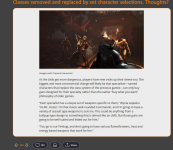
Tripwire, you guys still have time to revert this decision. Players are furious over not having the freedom to choose their own character and perk.
No, personally, I don’t want my character to have an identity. I want to choose a character, put a mask on him, or her, and shut off the voice acting, so I can have the shooting immersion portion of the game intact. Other players want to put Christmas pyjamas on, and wear halloween hats. That’s what they like, why would you take that fun aspect of the game away from the fans?
Removing choices, and forcing the player to select a pre-made character, with a pre-made set of guns, is the wrong choice. That is not how Killing Floor works.
I get it, you want the game to appear dark, and atmospheric.
Okay, how about you make weapon skins, and gear that is less flamoboyant, and fruity then? Even if you do make some stuff dark and gritty, and some stuff fruity, then you have made both sides happy. Taking those options away punishes everybody.
I urge you, to reconsider this decision, before continuing to mess with what has been proven, and works.
The community would prefer customizability, and the freedom to play what they like, how they like.
You know this, now what will you do with that information?
I could complain about other things, like the blood splashes flying right through the floor, in 2024, “this sort of thing should not be happening anymore”, when I know your team can do this better. The degraded looking gore effects compared to FLEX gibs, and fluids. But really, put some love into your game, and think about us, before you consider putting a “Watermark”, on this product.


Multithreading is a powerful technology that allows a program to run many threads concurrently, enhancing speed by efficiently using multiple CPU cores. While PHP is not well recognised for its multithreading capabilities, there are extensions and frameworks that may be used to achieve multithreading in PHP
In this article, you’ll learn how to implement multithreading in PHP, step by step.
What is Multithreading?
Multithreading is a concurrency method used in computer programming and software development that allows a program to run numerous threads of code at the same time within a single process. A thread is the smallest unit of execution inside a process, and it may be perceived as a separate or independent flow of control.
Checking the presence of pthreads extensions
- We use ‘extension_loaded(‘pthreads’)’ to check if the ‘pthreads’ extension is loaded. If it’s loaded, it means that multithreading support is available.
- If the extension is not loaded, we print an error message and exit the script with a status code of 1.
- Download the latest ‘pthread’ extension using the following link:
- http://windows.php.net/downloads/pecl/releases/pthreads/
- Copy and paste the “pthreadsVC2.dll” file in the “php” folder that is located inside your “xampp” folder.
- Copy and paste the “pthreads.dll” file in the “ext” folder that lies inside the “php” folder.
- Open your “php.ini” file and type the command “extension=php_pthreads.dll”.
- Save your “php.ini” file. Now you are ready to use your ‘pthreads’ extension.
Using pthread extensions
We define a new thread class called ‘MyThread’ , which extends the ‘Thread’ class provided by the ‘pthreads’ extension. The ‘run’ method defines the code that will be performed within each thread.
We create an array ‘$threads’ to store instances of our custom thread class.
We create ‘MyThread’instances within a loop, start them with the ‘start()’ function, and put them in the ‘$threads’ array.
Another loop uses the ‘join()’ technique to wait for each thread to finish. This ensures that all threads have completed before proceeding.
Tip: Optimize workload distribution for better performance in multithreaded PHP apps.
Synchronization with mutexes
- First, we will define a ‘SharedResource’ class that contains a private mutex (‘$mutex’) and an array (‘$data’) to store shared data.
- To ensure exclusive access, the ‘addToData’ function of ‘SharedResource’ locks the mutex before adding a value to the shared data array and unlocks it afterwards.
- Each ‘MyThread’ instance is given access to the shared resource in its constructor. In the ‘run’ method, each thread adds a value to the shared data using the ‘addToData’ method.
- After creating and starting the threads, we wait for them to finish using the ‘join()’ method.
- Finally, we get and print data from a shared resource, demonstrating synchronized access to shared data. Caution: Beware of race conditions and synchronization issues when implementing multithreading in PHP. ##Some Alternative Approaches We can also use an alternative method that is ‘pcntl’ extension which helps us in achieving parallelism in php. Parallelism in PHP refers to the execution of multiple tasks or processes simultaneously.
A. Using ‘pcntl’ extension
The ‘pcntl’ PHP extension provides process control capabilities, enabling you to create and manage child processes. While it does not support multithreading, it may create parallelism by running distinct processes concurrently.
- An empty array ‘$processing’ is created to store child process IDs (PIDs), and ‘$process_Count’ is set to ‘5’ to specify the number of child processes to create.
- A loop is used to create child processes. Inside the loop:
- ‘pcntl_fork()’ is called to create a new child process.
- If the fork fails (‘$pid == -1’), the script exits with an error message.
- In the child process (‘$pid == 0’):
- It prints a message with its PID.
- Simulates work by sleeping for ‘2’ seconds.
- Exits the child process.
After creating all child processes, the parent process loops over the ‘$processing’ array, calling ‘pcntl_waitpid()’ to wait for each child process to finish. This assures that the parent process does not complete execution until all child processes have completed. While ‘pcntl’ enables parallelism in PHP via process management, it’s important to remember that processes are more isolated than threads, making communication between them more difficult. Depending on your application’s needs, you should choose between ‘pthreads’ and ‘pcntl’.